
“Idiot Jungler” Isn’t Bannable? Riot’s New Chat Rules Spark Heated Debate
March 9, 2026

League of Legends Patch 26.5 arrived on March 4, 2026, bringing champion balance changes, a new CS Assist Indicator for beginners, and a significant overhaul to how Riot handles toxic communication. The LoL 26.5 chat ban system introduces a fundamental shift: for the first time, players who engage in severely abusive communication will receive gameplay bans rather than just chat restrictions—meaning they lose access to the game entirely.

New Chat Ban System: From Chat Restrictions to Account Bans
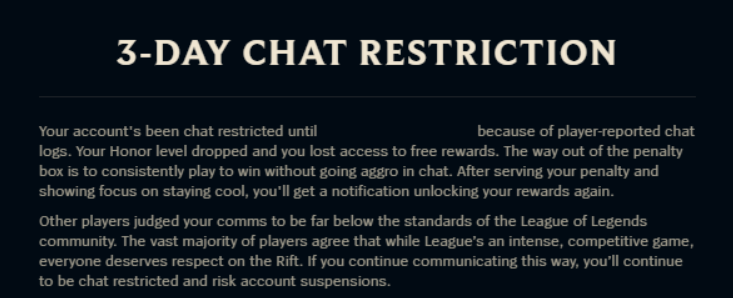
Riot’s developer blog, authored by just a capybara, announced a fundamental shift in how the game handles toxic communication . Previously, players who engaged in abusive chat received chat restrictions—they could still play, just with limited ability to communicate. But the team agreed with community feedback that “it feels wrong to see players who said awful things queuing up for more games immediately” .
LoL 26.5 Chat Ban System Overview
| Severity Level | Examples | Penalty |
|---|---|---|
| Mild Flame | “Idiot jungler why aren’t you ganking my lane?” | No immediate ban, repeated offenses escalate |
| Severe Abuse | Hate speech, threats of violence, extreme aggression | Direct gameplay ban (account suspension) |
| Repeated Offenses | Pattern of mild flame over time | Chat restriction → Ranked restriction → Temporary ban |
The key change is the introduction of immediate gameplay suspensions for severe cases. Players who cross the line with hate speech, threats of violence, or extreme aggression will now find themselves unable to queue for matches at all . This represents a significant escalation from the previous system, where even severe offenders could continue playing while muted .
Riot explained that they want to remove players who say “truly awful things” from the player pool entirely, rather than allowing them to continue ruining games without the ability to type . The new system is rolling out gradually across all regions, with Patch 26.5 marking the initial implementation .
The “Idiot Jungler” Controversy: Where Is The Line?
The controversy stems from Riot’s own communication about the new system. In their explanation of what constitutes “mild” versus “severe” abuse, they provided the example sentence: “idiot jungler why aren’t you ganking my lane” . According to Riot, this type of language does not warrant an immediate gameplay ban, though repeated offenses could lead to escalating penalties .
Players immediately pushed back on social media and forums. Many argued calling someone an “idiot” is clearly insulting and should not be normalized as acceptable behavior . Others questioned the consistency of enforcement—if “idiot” is mild, what specific words trigger the severe threshold?
The confusion reflects a broader challenge in content moderation: where exactly to draw the line between frustration and abuse . Riot’s position appears to be that a single insult, while not ideal, doesn’t warrant removing a player from the game entirely. However, patterns of such behavior will still address through their existing progressive penalty system.
The debate also highlights cultural differences in what constitutes acceptable trash talk . What one player considers mild banter might feel like a personal attack to another, and Riot’s moderation team faces the difficult task of applying consistent standards across millions of players worldwide.
CS Assist Indicator: New Player Tool Explained
Beyond the chat system controversy, Patch 26.5 also introduces a significant quality-of-life feature for new players: the CS Assist Indicator . This tool helps beginners learn the art of last-hitting by providing visual and audio cues when minions reach killable health thresholds .
The indicator is enabled by default for new accounts but can be toggled on or off in the settings menu at any time . Veteran players who find it distracting, Riot recommends disabling the feature immediately, as it’s not intended for experienced summoners .
The tool addresses one of League of Legends’ steepest learning curves. New players often struggle with CSing (creep score), falling behind experienced opponents who have internalized damage thresholds through hundreds of games . By providing clear visual feedback, Riot hopes to help newcomers focus on other aspects of gameplay while they develop their last-hitting instincts naturally.
In the competitive scene, this change does not directly impact players—First Stand 2026 will proceed without any assistance tools. But for the broader player base, it represents Riot’s ongoing commitment to making League more accessible without diluting its competitive depth.